Written by PBA Visionary Member Selfnamed
For the longest time, the beauty industry was extremely challenging for newcomers to enter. Now, thanks to democratized manufacturing, the beauty space isn’t solely a playground for companies backed by billions of dollars.
Democratized manufacturing has opened doors for aspiring founders, small businesses, and creators to create products and launch brands with low barriers. It’s a shift toward more accessible and decentralized production models without the need for capital investment.
Due to technological advances and innovative companies launching a beauty product can take significantly less time — days and weeks, instead of years.
Let’s see what’s actually impacted the rise of democratized production and why it’s becoming the go-to choice for many beauty brands!
Democratized Manufacturing on the Rise
The Rise of Micro-Brands and Indie Beauty
Here’s a fact: the number overall of small businesses being established is growing. We have the pandemic to thank (bear with me) for the rapid and continuous rise of micro-beauty brands over the past 5 years. But there are some other, deeper reasons why beauty brand founders decided that now’s time to act.
With the hyper-connectivity that the online and ecommerce world blesses us with, building a brand and its story has become increasingly easier and more accessible. You can build community and the brand as you go with just a few clicks.
This way founders also have direct communication channels with the customers making feedback gathering so much quicker than before. And it’s instant, 24/7/365!
Another big reason is the fact that in the past years, consumers have realized the importance of supporting small brands and giving back to their own community, instead of big corporations. It’s a value-driven way for people to vote with their hard-earned money and to enable growth of micro and indie brands.
Making a micro-brand is possible when factors like these come together and when democratized manufacturing options are available. Most beauty micro and indie brand owners have limited financial assets as they start out, so they opt to go for more-cost efficient production methods, like skincare dropshipping.
Small-Batch and Sustainable Production Trends
Undeniably, sustainability beauty has been a huge topic among the modern consumers. According to a 2025 research by GlobeScan, nearly half of Americans or 49% have bought a sustainable product in the last month, but about 36% have expressed desire to do so.
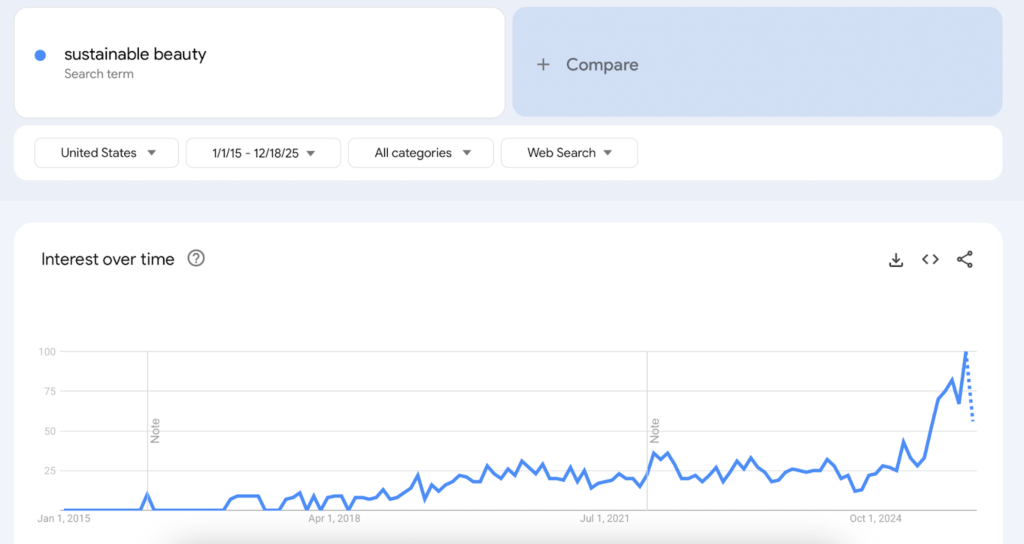
Google Trends showing the trend line for the search term sustainable beauty in the US over the last 10 years.
One of the ways how democratized manufacturing has manifested itself most visibly is through small-batch production which inevitably is also more sustainable in the grand scheme of things. Brands are now looking for ways to eliminate waste and excess inventory through producing limited ranges instead of wasting money on thousands of units that might not sell.
One of the ways for beauty brands to save money and produce smaller batches is working with manufacturers and suppliers with low or no minimum order quantities. That way the company holds very little or no stock on hand, freeing financial assets that would rather be tied up in physical products.
Another precious advantage of small-batch production is that it gives brands more freedom to learn quickly, experiment with their offering, and see what their customer drifts toward. An experimental, no-MOQ, on-demand only run can go two ways: either it’s a success or it doesn’t sell at all. The beauty of demand-led production is that you’re not risking losing almost any money in the process.
Consumer Preference for Clean, Transparent, and Local Beauty Brands
We already touched upon how there’s an on-going cultural shift happening toward supporting smaller brands. The beauty industry is ever-changing, and perhaps now more than ever, consumers are drawn to fact-based values and brands they can feel close to.
Information about different business and manufacturing practices is widely available and isn’t hidden behind a veil of secrecy and industry-only knowledge. The availability of online resources and rich informational exchange has made the consumers more educated and more aware of how different types of production impact the planet and themselves.
The customers now have the power to change the way beauty and wellness brands operate, and also the industry as a whole. You can see it in action every day – more and more businesses in the sector are committing to more environmentally-friendly practices and adapting ESG (environmental, social, and governance) strategies to keep up with increasingly demanding and aware customers.
That’s why transparent, clean beauty, and more local beauty brands are gaining popularity. It’s important for the modern shopper to know and understand exactly what’s in their product, and where it comes from to judge their own direct and indirect impact.
What’s more, democratized manufacturing enables beauty brands and their founders to adapt to these shifts by creating products more mindfully, transparently, and eco-friendly.
Data Doesn’t Lie: Market Insights
It’s clear that democratized manufacturing has changed so many dynamics, from the decision to establish your own beauty brand to better catering to the customer’s needs and wants.
And the data supports it! Here are some important statistics for you to keep in mind that’ll be helpful for you as a founder no matter if you’re at the beginning of your business journey or if you’re thinking how to further build a better relationship with your customers.
- 47% of global consumers admit that their shopping decisions are impacted by the fact that the company is locally-owned (McKinsey&Co, 2025),
- 55% of global consumers are flexible and open to trying new brands (BCG, 2025),
- 26% of global customers actively research and use apps to scan products in the store to understand the ingredients (Euromonitor International, 2025),
- Gen Z is the leader in prioritising sustainability for themselves, reaching a whopping 67%, and 56.2% are willing to pay more for sustainable products (Attest, 2025),
- More than 35% of global consumers are purchasing more private label products (NIQ, 2025),
- 87% of customers are ready to pay more for products from small businesses (NMI, 2024).
Final Thoughts
Thanks to democratized manufacturing, creating a business is more affordable and attainable for many with a dream. Luckily, we’re behind times where the beauty industry is a closed-circle. Now we’re moving toward a more collaborative and mindful future. It’s empowered founders that truly care about their brand’s impact on the consumer and the world around us.
Not only is it easier to create purposeful, mission-driven businesses, the consumers are realizing that supporting micro and indie brands is both crucial for the business’ survival, but can also support their values of community, transparency, and sustainability.
And consumers are indeed a large reason for breeding the innovation that’s allowed democratized production – with their continued demands for clean practices and continued education about manufacturing methods and their implications.
What does it mean for your brand? You have the chance from the ground-up to prioritize more demand-led, sustainable manufacturing of your products. Your advantages lay in being more agile, relevant, and able to experiment with the offering (especially, if you opt for an on-demand production model). As we thoroughly looked at, it’s also about creating a deep, trustworthy relationship with your customers, as long as you involve them in the conversation and are open to sharing how you operate.
At the end of the day, democratized manufacturing is also a challenge. A challenge that makes you evaluate how success looks like for you. You might not be the next Gucci or Chanel, but the impact you make on your community, the planet, and the industry altogether could prove to be immeasurable.
FAQ
- What is democratized manufacturing in beauty?
Democratized manufacturing is a way to make the production of goods more accessible for everyone, especially aspiring founders and small businesses. It’s a shift toward more accessible and decentralized production models without the need for capital investment.
- How do micro-brands influence consumer trends?
Consumers have realized the importance of supporting small brands and giving back to their own community, instead of big corporations. Shopping small for many people is value-driven, and it greatly enables the growth of micro and indie brands. And to put very simply, it’s more trendy to shop small than it was, say, 20 years ago, but this time – for the right reasons, such as the demand for transparency and sustainability.
- Why are consumers choosing sustainable and local beauty products?
Consumers are choosing sustainable and local beauty brands, because they’re more aware of how their purchases impact the environment and themselves. Customers are now more educated than ever and can freely access information about harmful ingredients, additives, and overall what’s good and what’s not so good for them.
Choosing local and sustainable products also minimizes things like unnecessary waste and transport emissions.
- What does the future hold for small-batch and indie beauty brands?
The future for small-batch and indie beauty brands is promising! Tech advancements and innovations in production methods enabled by democratized manufacturing are helping founders create brands that require low upfront investment and are friendlier to the environment.