By Joel Weinstein, President, and Editorial Director of Bass Brushes. Joel is a multi-patented hairbrush designer and leads the team behind the Bass Education & Insights Journal, the company’s structured platform for professional and consumer education. This article expands on Bass’s broader educational textbook on hairbrush types, function, selection, technique, and history.
Key Takeaways
The Hairbrush Endures Because It Serves a Lasting Human Need.
The hairbrush remains essential because it helps bring order, beauty, identity, and intention to hair through a simple but deeply functional tool.
Brush Selection Should Begin With Function.
The best brush is not one generic tool for everyone; it should be chosen based on what the user needs the brush to do, along with hair type, material, construction, and desired result.
Boar Bristle Brushes = Shine and Condition
Boar bristle brushes help distribute natural scalp oils, smooth the hair surface, improve shine, reduce roughness, and create a polished, conditioned finish.
Pin Brushes = Style and Detangle
Pin brushes separate strands, release tangles, direct the hair, support styling control, and create comfortable scalp contact through thoughtful pin spacing, flexibility, and tip design.
Round Brushes = Straighten, Curl, and Shape
Round brushes use tension, airflow, rotation, barrel diameter, and material behavior to create smoother lines, volume, waves, curls, and finished shape.
Introduction
Today, our personal and professional lives are supported by modern machines of remarkable power. Digital devices make our lives more efficient, more precise, and more accessible at a scale that previous generations could barely have imagined.
In a world shaped by constant innovation, it is easy to overlook the enduring objects of design that have remained essential and relatively unchanged across generations. Some tools evolve slowly because their purpose remains deeply relevant. They continue to serve daily life because they answer a lasting human need and were designed correctly from the start.
In a time of rapid change, there is value in reflecting on foundation, endurance, and stability. Few personal care tools express those qualities more clearly than the hairbrush.
History
Hair is naturally dynamic. It tangles and twists. It shifts and sways. It bends, breaks, and resists perfect order. Across cultures and generations, the hairbrush has endured because it answers one of the oldest grooming needs: the desire to shape, smooth, arrange, and bring intention to the hair.
Long before modern styling appliances, cosmetic formulas, and today’s specialized grooming implements, people used crafted materials to interact with the hair in a controlled and purposeful way. Pins, bristles, filaments, handles, and graspable forms evolved around a simple but lasting function: to prepare the hair, direct it, refine it, and stabilize it into an ordered shape.
That practice has always been more than utility alone. To brush the hair is to bring order to something naturally untamed, and to turn that order into beauty, identity, and personal presentation.
The Modern Hairbrush as a Functional System
Amazingly, the hairbrush has retained its essential design logic across the ages. Materials, finishes, shapes, ergonomics, and functional scope have certainly evolved, but like an unbroken thread across time, the core architecture remains recognizable:
Bristles or pins attached to a handle, designed to interact with, guide, and set the hair.
What has changed is our level of expertise in optimizing this essential tool. Modern hairbrush design is no longer only about whether a brush can pass through the hair. It is about how the brush performs: how it moves, how it feels in the hand, how it responds to different hair types, how it supports specific techniques, and how it helps create desired outcomes with greater comfort, control, precision, and intention.
Today, hairbrushes vary widely in appearance, material, construction, and specialized features. Most brushes serve more than one purpose, but most can be understood primarily through several core functional roles:
- Shine & Condition:
- Brushes that distribute natural scalp oils to smooth, soften, and polish the hair.
- Style & Detangle:
- Brushes that separate, detangle, and direct the hair.
- Straighten & Curl:
- Brushes that help shape the hair into lines, waves, curls, and finished forms.
Exploring and understanding these functional roles helps turn the hairbrush from a familiar everyday object into a purposeful tool of selection, technique, and personal expression.
Shine & Condition: Boar Bristle Hairbrushes
Ironically, one of the oldest brush forms remains one of the most desired and functionally important. Natural boar bristle brushes are valued for their ability to help distribute sebum, the natural oil produced by the sebaceous glands of the scalp, along the hair shaft.
Sebum, often just called oil, is an incredibly potent totally natural and biocompatible conditioning agent.
Since boar bristle has a fibrous structure that interacts well with natural oils, it is especially effective for polishing, softening, and conditioning the hair through regular dry brushing. As the brush moves from the scalp through the lengths, it helps carry natural oils away from the root area and toward the mid-lengths and ends, where hair is often drier and more vulnerable to roughness.
The result is hair that can appear smoother, more reflective, and more naturally conditioned. With continued use, boar bristle brushing may help improve manageability, reduce surface roughness, minimize static and frizz, and make strands feel more lubricated so they separate more easily rather than catching and tangling.
In this sense, the boar bristle brush is not simply a styling tool. It is a conditioning tool — one that works with the hair’s own natural oils to support shine, softness, polish, and a healthier-looking finish.
Beyond The Shine: Other Applications for Boar Bristle Hairbrushes
Professionally, boar bristle brushes are also valued as finishing, polishing, and refinement tools because the dense tufts of small flexible filaments interact with hair at hundreds of precise contact points, the hairbrushes excel at:
- Smooth surface layers,
- Control fly-aways,
- Blend styled sections,
- Support sleek ponytails, buns, and updos
- Create a more unified, light-reflective finish without disrupting the overall shape.
They can also help distribute small amounts of finishing product evenly across the hair surface, refine the outer layer after volume work or back-brushing, and support grooming for shorter hair by helping direct, polish, and condition the hair. In salon work, the boar bristle brush is not about aggressive detangling and more about control, surface refinement, softness, shine, and final presentation.
When Pure Natural Boar Bristle Is Not Enough: Porcupine-Style Brushes for Thicker Hair
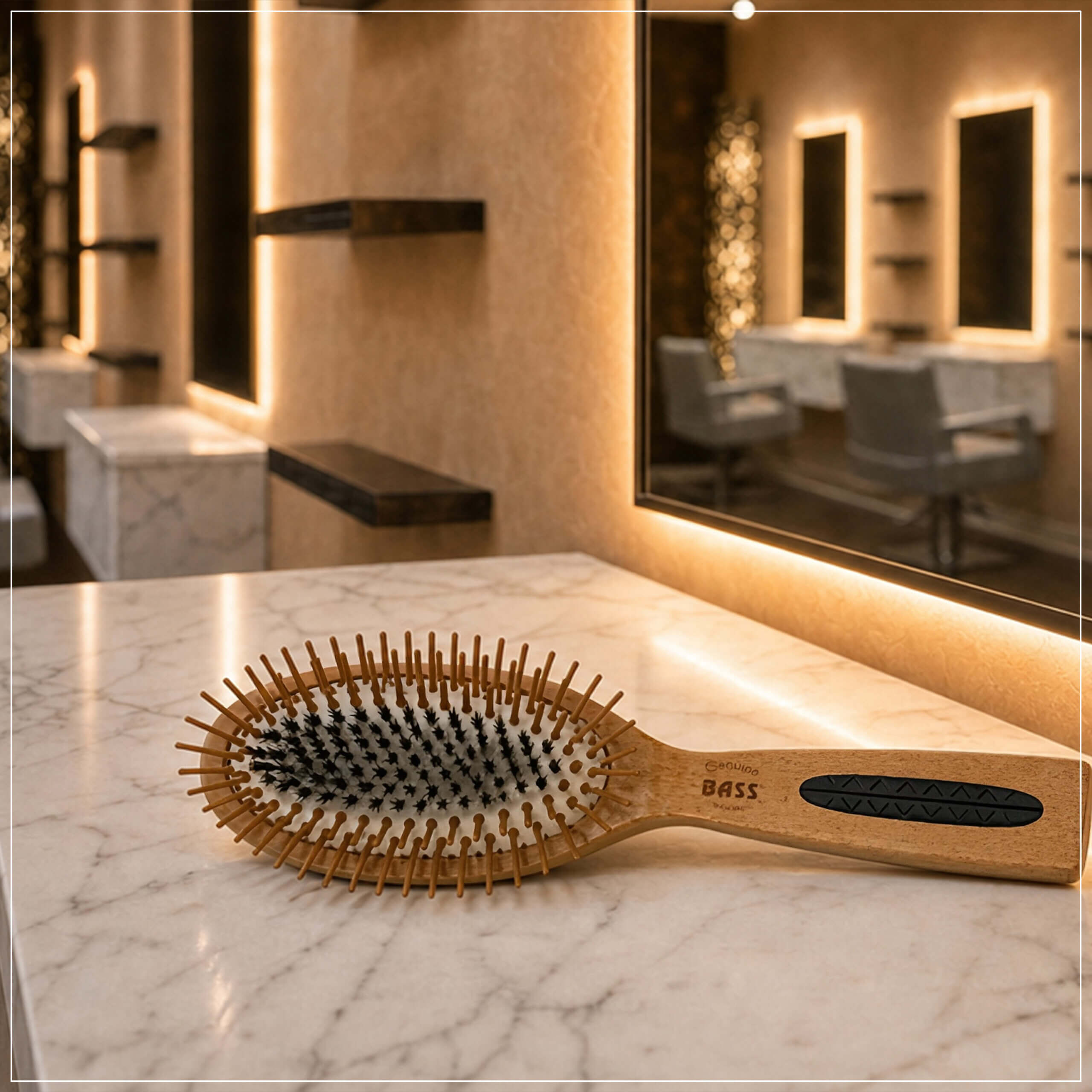
One classic hairbrush form combines natural boar bristles with a single, flexible nylon pin planted within each tuft of bristle. In some designs, this may appear as one or two longer pins rising from each bristle cluster. This construction is commonly known as a “porcupine” style brush.
The nylon pin does not distribute natural oils in the same way as boar bristle, so its purpose is different. Natural boar bristle is excellent for smoothing, polishing, and helping move sebum from the scalp through the hair. However, because boar bristles are fine, densely grouped filaments, they may not fully penetrate medium to thick hair, especially when the hair has multiple layers or greater density.
The longer nylon pin helps solve that problem. Because it is taller and wider than the surrounding boar bristles, it can reach more deeply into the hair, gently separate the strands, and create a path for the full brush to move through more easily. This allows the boar bristles to make better contact with more of the hair surface, including areas closer to the scalp where natural oils are produced.
In this way, the porcupine-style brush combines two functions: the nylon pin provides reach, separation, and glide, while the surrounding natural boar bristles provide polish, softness, and natural oil distribution. For medium to thick hair, this combined structure can make the shine-and-condition function more effective than pure boar bristle alone.
Beyond Porcupine: Advanced Hybrid Brush Design
A modern advancement solves the penetration problem by separating the brush’s functions more intentionally. In a traditional porcupine-style brush, the longer pin and the natural bristles are planted within the same tuft, so the pin helps open a path while the bristles polish and condition.
In a more refined construction, the separating elements and conditioning elements can be arranged as distinct working zones. Longer and more rigid pins form an outer layer on the brush face and first move through the hair to create separation, glide, and access to deeper layers, while an inner core section of concentrated natural bristle follows or works within that opened path to contact more of the hair surface and help distribute natural oils.
This innovative approach also allows for more variation in the pin zone of the brush. Because of manufacturing limitations, porcupine style must employ a thin nylon separator pin planted in the center of a tuft of finer bristles, whereas the “Dual-Zone” approach allows for thicker pins that have larger diameter such wood, metal alloys, bamboo, or even thicker nylon all of which have additional benefits for the desired result.
This design logic preserves the polishing and conditioning benefits of natural bristle while improving reach, movement, and performance on medium to thick hair. The result is much better glide and less pull or drag through medium and thick hair compared to the traditional porcupine setting.
Synthetic Boar-Style Bristles: Similar Form, Different Performance
Synthetic boar-style bristles are made from nylon and may be produced with a similar diameter, appearance, and tufted arrangement to natural boar bristles.
When planted densely in a brush, they can mimic some of the surface interaction pattern of natural bristle by creating many small contact points across the hair.
These bristles can serve a useful purpose for smoothing, tensioning, surface control, and styling refinement. They are also generally less expensive and highly durable. However, there is one core functional distinction that professionals should understand: synthetic bristles do not condition the hair by absorbing and redistributing natural scalp oils in the same way as natural boar bristle.
Nylon is a smooth, non-fibrous material. It does not have the same organic structure that allows natural boar bristle to capture sebum from the scalp and carry it along the hair shaft. For this reason, synthetic boar-style bristles may resemble natural bristle in form and may provide some similar styling control, but they should not be treated as functionally equivalent for natural oil distribution, conditioning, and shine.
Summarizing the Role of Boar Bristle Brushes
Taken together, boar bristle brushes occupy a distinct place within the hairbrush system. Their primary value is not forceful detangling or dramatic reshaping, but refinement: distributing natural oils, smoothing the surface, improving shine, supporting softness, and creating a more polished finish. Whether used in pure natural form, combined with longer separating pins, or compared against synthetic alternatives, the central idea remains the same: this category is about conditioning, surface control, and finish.
With the hair softened, polished, and more receptive to movement, the next question becomes how to prepare it for separation and direction.
Style & Detangle: Pin Brushes
Hairbrushes with rigid or semi-flexible pins are the ones used for separation and directional management.
Unlike boar bristle brushes, which primarily refine the surface and help distribute natural oils, pin brushes are designed to enter the hair, move through its layers, separate strands, release tangles, and guide the hair into a chosen direction.
The spacing, flexibility, length, and tip design of the pins determine how the brush interacts with different hair types and textures. Softer, more flexible pins are often better suited for gentle detangling, while firmer pins provide greater control for styling, sectioning, and directing the hair into an intended shape.
In this category, the brush becomes less about polish and more about preparation, movement, control, and manageability.
Detangling Vs. Styling
Detangling and styling are related, but they are not the same function. Detangling is primarily about separation: the brush must move through the hair gently, release knots, reduce snagging, and help strands separate without unnecessary pulling or breakage. Soft, flexible pins work well for this step because they can bend and move around resistance rather than forcing through it. However, those same qualities can limit their usefulness for styling, especially when heat is involved. Very flexible pins often lack the structure needed for intentional direction, tension, and shaping, and thinner detangling pins may not be ideal for repeated use with blow-dry heat.
Styling is about direction. The brush must provide enough control to guide the hair into a chosen shape, part, flow, or finish. For this reason, the broader category of pin brushes can vary widely in feel and performance. Softer, more flexible pins are often preferred when the goal is gentle detangling, especially on wet, fragile, or knot-prone hair, while firmer or more structured pins are better suited for directional control, heat-assisted styling, tension, and shaping. In simple terms, detangling prepares the hair; styling organizes and directs it.
Pin Materials in Styling Brushes
Within styling brushes, pin material has a direct effect on control, comfort, heat behavior, and the way the brush moves through the hair. Nylon pins are common because they are lightweight, flexible, and smooth through the hair. When finished with a ball tip, they can provide a rounded contact point against the scalp, which may improve comfort during general brushing and styling. When finished with a radius tip instead of a separate ball, the pin has a smoother integrated end that can move cleanly through the hair while reducing the risk of snagging around the tip.
Metal alloy pins create a different brushing experience. They are typically more rigid and precise, which can make them useful for stronger directional control, sectioning, styling tension, and scalp stimulation. Because metal conducts and retains heat more readily than many other pin materials, it can respond differently during blow-dry styling. This can support shaping in some contexts, but it also requires professional awareness because the pins may become warm during repeated exposure to heat.
Wood and bamboo pins offer another important performance profile. They are naturally rigid enough to separate and direct the hair, yet they do not melt under normal blow-dry heat exposure. Unlike metal, they also do not retain heat in the same way, which can make them appealing for users who want structure, scalp comfort, and heat resilience without the thermal behavior of metal pins. This gives wood and bamboo pins a strong functional identity: they combine natural material character with practical performance, offering control, separation, and a smooth brushing feel while remaining well suited to everyday styling use.
Scalp Stimulation and Brush Contact
Styling brushes with more structured pins do more than separate and direct the hair. Because their pins are designed to reach through the hair and make contact with the scalp, they can also provide a stimulating tactile experience during brushing. Ball tips and radius tips both serve an important role here: they create a smoother contact point between the pin and the scalp, allowing the brush to glide, press, and move without the sharper feel of an unfinished pin.
This contact can make brushing feel more invigorating, grounding, and complete. As the brush moves across the scalp, the pins create gentle pressure and movement that awaken the surface, encourage sensory awareness, and turn a simple grooming step into a more intentional personal care ritual. This is one reason the language of Gua Sha-inspired scalp stimulation has become so relevant in modern grooming: people are increasingly interested in tools that do more than manage hair appearance. They want tactile, sensory experiences that make grooming feel restorative, refined, and physically satisfying.
The key is balance. The pins must be firm enough to reach the scalp and provide control, but smooth enough at the tip to remain comfortable. A well-designed styling brush should separate the hair, guide it into shape, and create pleasant scalp contact without scratching, pulling, or feeling harsh. In this sense, scalp stimulation is not a separate luxury feature; it is part of the way a properly designed styling brush connects function, comfort, and grooming pleasure.
Styling Is Expression
If boar bristle brushes are for refinement, styling brushes are for expression. This class of tools helps craft the distinctiveness, character, and visual direction of the hair in a way that can emphasize a person’s strongest features and individual style.
Through separation, direction, lift, tension, and control, styling brushes help move the hair from its natural state into a more intentional form. They support the choices that make hair feel personal: where it parts, how it falls, how much volume it carries, whether it looks relaxed or polished, soft or structured, understated or dramatic. In this sense, styling is not simply about arranging hair. It is the act of shaping visible identity through movement, proportion, texture, and flow.
However, the system is not fully complete. If boar brushes refine and pin brushes style, we still need to shape the structure. That is the bridge.
Straighten & Curl: Round Brushes
Round brushes create shape through controlled tension with heat application and unlike flat brushes, round brushes interact with the hair on 3 axes:
Lengthwise axis: the brush moves along the hair shaft, creating smoothing, stretch, and directional control from roots to ends.
Radial axis: the hair wraps around the circular barrel, creating bend, curve, wave, curl, or volume.
Rotational axis: the brush turns through the hand, using rotation and tension to guide how the hair forms and releases.
Diameter is closely related to shape outcome:
Large Diameter = Straight Lines
Medium Diameter = Gentle Waves
Small Diameter = Tighter Curls & Loops
In this sense, round brushing is where grooming becomes architecture. The stylist is not only arranging the hair, but building form into it through geometry, tension, airflow, and controlled release.
Round Brush Types and Barrel Design
Round brushes can vary significantly in barrel construction, and these differences affect airflow, heat behavior, tension, weight, and the kind of finish the brush helps create. While diameter determines much of the shape outcome, barrel design influences how efficiently the brush works during blow-dry styling.
Vented round brushes allow air to pass through openings in the barrel. This can speed drying, reduce trapped heat, and make the brush feel lighter and more responsive during use. Because airflow moves through and around the section of hair, vented brushes are often useful when the goal is efficient drying, lift, volume, and general shaping.
Non-vented round brushes create a more solid surface for the hair to wrap against. This can provide stronger tension, smoother compression, and more controlled shaping. Rather than maximizing airflow through the barrel, the brush relies more heavily on surface contact, hand technique, and controlled blow-dryer direction. These brushes are often useful when the goal is polish, smoothing, and a more refined finish.
The material of the barrel or base also matters. Metal and ceramic barrels interact with heat more actively because they can warm during blow-dry styling. This may support faster shaping and more pronounced setting, but it also requires heat awareness and proper technique. Ceramic and tourmaline-coated barrels are often used to promote smoother glide and more even heat behavior, helping the hair wrap and release more cleanly during styling.
Non-metal bases, including wood, bamboo, and other heat-resilient materials, create a different experience. They do not retain heat like metal, which can make them appealing for users who want round brush control without relying heavily on a heated barrel effect. Their value is often found in structure, grip, comfort, material character, and controlled shaping through tension and airflow rather than stored heat.
In practice, no single barrel type is universally best. A vented ceramic brush, a solid natural-material brush, and a metal-based round brush can all be useful when matched to the right technique and desired outcome. The professional question is not simply which round brush is “better,” but which combination of diameter, barrel construction, material behavior, and airflow best support the shape being created.
Summarizing the Functional Hairbrush System
It’s incredibly common for clients to ask a basic question:
“What’s the best brush for me?”
The answer is rarely a single brush. The answer to this question begins by asking another question. What does the brush need to do?
Does the client need refinement, softness, shine, and natural conditioning? Then the conversation begins with boar bristle and the Shine & Condition category.
Does the client need separation, detangling, movement, and directional control? Then the answer moves toward pin brushes and the Style & Detangle category.
Does the client want smoother lines, waves, curls, volume, or a blow-dried shape? Then the answer belongs in the Straighten & Curl category, where round brush diameter, barrel type, airflow, and technique determine the result.
Most of the time the client wants all of these, and therefore the hairbrush should not be understood as one generic tool, but rather a well-structured system with various solutions whose structure matches the user’s hair type, grooming goal, and desired outcome.
When professionals explain brush selection through function, clients can move beyond confusion and begin to understand the brush as an intentional instrument of care, expression, and form.
Conclusion
In the end, the hairbrush endures because it remains both simple and profound. Its basic form has changed slowly, yet its possibilities continue to expand through better materials, better design, and a deeper understanding of how different tools serve different needs. A brush can refine the hair, prepare it, direct it, shape it, polish it, and help express the person who wears it. That is why the best brush is not merely the one that looks appealing on a shelf, but the one whose structure, material, and purpose align with the desired result. In a world filled with increasingly complex technology, the hairbrush reminds us that some of the most meaningful tools are those that remain close to the body, close to daily ritual, and close to personal identity — enduring instruments of care, technique, beauty, and self-expression.