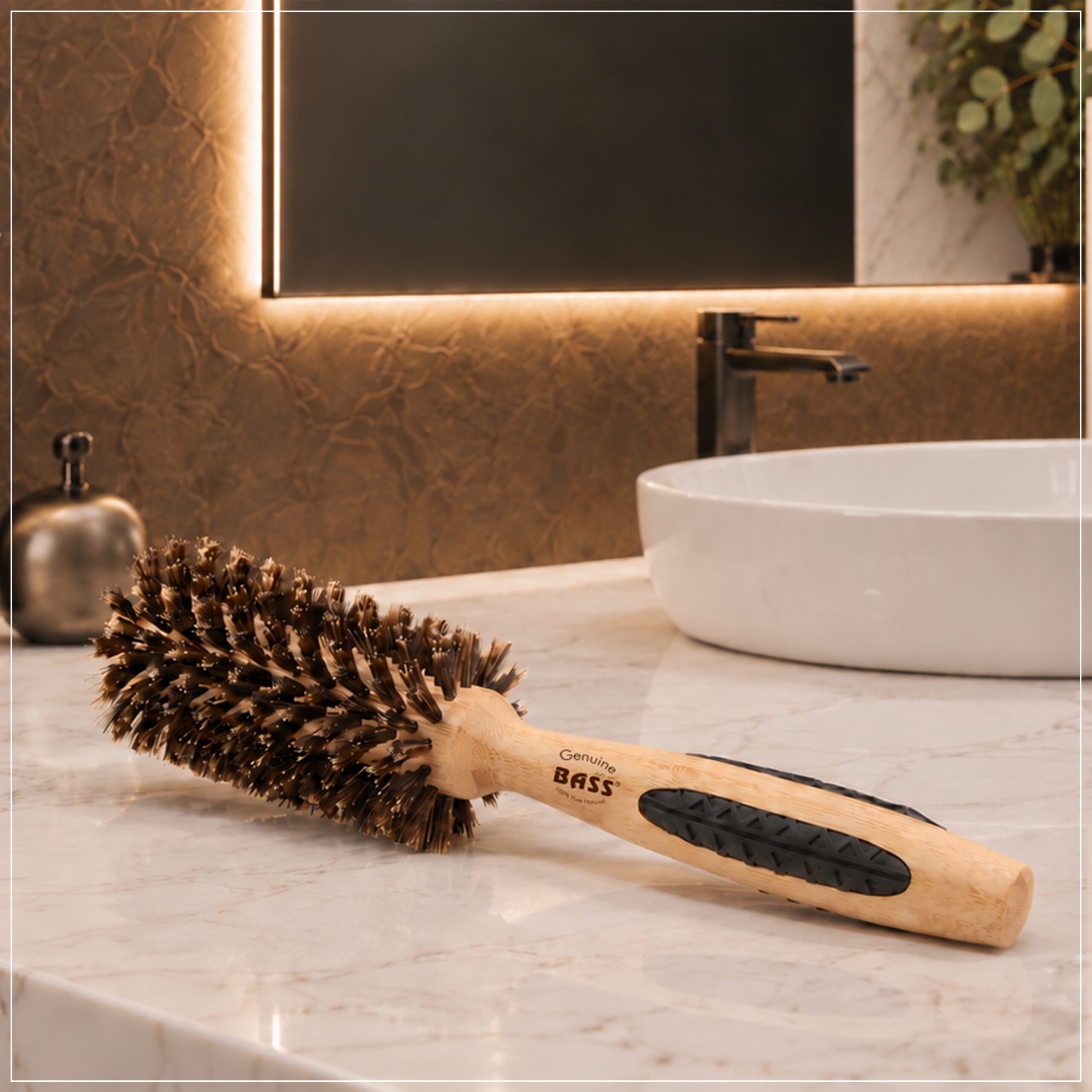
By Joel Weinstein, President and Editorial Director of Bass Brushes. This article is part of a special PBA series on Hairbrushes and expands on Bass Brushes’ broader educational textbook on round brushes.
Key Takeaways
• Round brushes are shaping tools used with a blow dryer to create straighter lines, bends, waves, curls, lift, movement, and end control.
• Start with the shape you want to create. Diameter is the first major physical choice.
• Larger diameters produce broader curves and straighter-looking lines. Medium diameters suit waves and movement. Smaller diameters allow tighter bends and curls.
• Small, medium, and large are relative terms. Actual barrel dimensions vary by manufacturer.
• Diameter, bristle system, barrel profile, ventilation, material, and ergonomics are separate variables and can be combined in many ways.
• Hair characteristics and section geometry help narrow the choice, but they do not replace the intended shape as the starting point.
Introduction: Choosing Among Round Brushes
A rack of round brushes can make a simple tool look surprisingly complicated.
Most share the same basic idea: a cylindrical or near-cylindrical working surface, bristles or pins, and a handle. Beyond that, the differences can be substantial. Diameter changes. So do bristle configuration, barrel profile, usable working length, ventilation, material, surface treatment, weight, balance, and handle design.
For a professional stylist, those differences matter.
Choosing a round brush for a professional blowout involves much more than selecting a barrel marked small, medium, or large.
A traditional round brush is a manual shaping tool used primarily with a separate blow dryer. It helps establish form while the hair dries, whether the aim is a straighter line, a broad bend, a wave, a curl, or a tighter turn. Root lift, smoothing, movement, and end control often come into play at the same time.
Hot-air brushes, heated brushes, and other powered styling tools can also shape the hair, but they combine functions differently. They are outside the scope of this discussion.
The best place to begin is with the result you want.
What shape are you trying to create?
That answer points toward a diameter. Hair characteristics and section size then tell you whether that diameter is practical. Bristles and pins determine how the brush will meet and control the hair. Barrel design affects working geometry and airflow. Materials and thermal construction influence the physical behavior of the tool. Weight, balance, and handle design affect the stylist’s control.
Round-brush selection is therefore less about finding one superior feature and more about assembling the right combination for the work at hand.
Start With Shape: Diameter Comes First
A round brush gives the hair a curved surface to follow while it dries. Change the diameter and you change the scale of the curve that surface can create.
Larger barrels create broader arcs. Smaller barrels allow tighter turns.
Large-Diameter Round Brushes
Large barrels are suited to straighter-looking lines, broad bends, and softer movement.
Because the radius is gradual, the hair can travel across the barrel with relatively little curvature or be carried farther around it for a broader bend.
A large diameter should not be confused with volume, however.
Volume depends on section elevation, direction, overdirection, placement, drying, cooling, and release. A large brush may be part of a full, lifted blowout, but the same barrel can also be used to create a smooth result that stays comparatively close to the head.
Its primary contribution is the breadth of the curve.
Medium-Diameter Round Brushes
Medium diameters sit between broad shaping and tighter curling. They work well for waves, movement, body, and moderate bends. There is enough curvature to make the shape visible without creating the tighter turn associated with a smaller barrel.
Small-Diameter Round Brushes
As the barrel gets smaller, the available curve becomes tighter.
Small diameters suit curls, stronger bends, tighter turns, and more detailed shaping. Reducing the diameter further increases that potential.
In practical terms:
Larger diameter = broader curvature
Smaller diameter = tighter curvature
The labels themselves deserve some caution.
“Small,” “medium,” and “large” are not universal industry measurements. One manufacturer’s medium may be another manufacturer’s large. Published dimensions may be given in inches or millimeters and may refer to the structural barrel alone or, in some cases, to the overall diameter including the bristles.
Whenever an actual barrel measurement is available, it is more useful than the size name.
Diameter gives the stylist a starting point. The next question is whether that diameter can be used effectively on the hair being styled.
Refine the Diameter for the Hair, Section, and Working Area
Hair length affects which barrel sizes are practical, but it should not decide the choice by itself.
A short section may not travel far enough around a very large barrel to establish the intended shape. Longer hair usually gives the stylist access to a wider range of diameters.
That is different from saying short hair requires a small brush or long hair requires a large one.
Length affects access. Shape remains the objective.
Density influences the choice in another way. A dense section may need to be divided more narrowly or engaged more deeply. That may point toward different sectioning or a different bristle system rather than a different barrel size.
Strand diameter also changes the working feel. Fine, medium, and coarse strands can respond differently to tension and reshaping.
The starting texture or pattern matters for the same reason. Hair that already carries a strong pattern may require a different degree of control than hair that begins relatively straight.
Condition and porosity affect how the hair responds to moisture, heat, tension, and repeated manipulation.
Section geometry is just as important.
A barrel may be perfectly suited to the intended curve and still become difficult to manage if the section is too wide or too deep. The working surface of the brush and the amount of hair placed on it have to make sense together.
Available space also changes from one area of the head to another.
The nape, hairline, crown, bangs, face frame, and longer interior sections do not offer the same room for movement. A stylist may switch between diameters during one service without changing the overall design.
Hair and section characteristics narrow the choice. They do not replace the intended shape as the reason for choosing the brush.
Choose the Engagement System: Bristles and Pins
Once the barrel size is appropriate, attention shifts to the way the brush engages the section.
Diameter and bristle configuration do different jobs.
A large or small round brush may use natural boar bristle, boar plus nylon pins, nylon pins, or synthetic bristles. The barrel supplies the curved working surface. The bristles or pins determine how the brush penetrates, grips, organizes, and travels through the hair.
Commercial terminology can be inconsistent.
For this article, nylon pin refers to longer projecting synthetic elements intended to reach more deeply into a section. Nylon bristle refers to shorter or tufted synthetic filaments.
The construction itself is more informative than the label on the package.
Natural Boar Bristle
Natural boar bristle creates dense, distributed contact across the section.
That contact can provide grip and controlled tension while the hair is shaped around the barrel.
Boar bristle also redistributes natural surface oils along the hair, which contributes to polishing and surface refinement.
For a stylist who wants broad contact and a refined finish, it can be an appropriate engagement system.
Boar Plus Nylon Pin
A boar plus nylon pin brush combines deeper and shallower forms of contact.
The longer nylon pins project beyond the surrounding boar bristles and reach farther into the section. The boar provides denser contact nearer the surface.
This arrangement can be useful when deeper penetration and separation are wanted without giving up the broader contact of natural bristle.
These brushes are sometimes sold under the traditional market term “porcupine,” although boar plus nylon pin describes the actual construction more clearly.
Nylon Pin
Nylon-pin round brushes rely more heavily on projecting pins.
Their behavior depends on pin length, spacing, stiffness, and flexibility. Those variables affect penetration, separation, directional control, glide, and the depth of the section the brush can engage.
This type of construction can be particularly useful when the stylist wants the brush to reach through more of the section rather than concentrating most of its contact near the surface.
Nylon Bristle and Other Synthetic Filaments
Synthetic-bristle round brushes may use shorter filaments arranged in dense or more open tuft patterns.
They should not be assumed to behave like longer nylon pins.
Filament stiffness, flexibility, density, spacing, projection, tip design, and heat tolerance can vary widely. Those differences affect grip, travel through the hair, and release.
Two brushes marketed simply as “nylon” may therefore work very differently.
Across all bristle systems, material is only part of the story. Length, density, spacing, stiffness, flexibility, projection, tuft arrangement, and tip geometry all influence the way the brush interacts with the section.
Choose the Barrel Architecture
Barrel diameter gets most of the attention, but the shape and length of the working surface matter too.
Barrel architecture includes its longitudinal profile, usable working length, and ventilation.
Straight Cylindrical Profile
On a traditional cylindrical brush, the working diameter remains generally consistent along the usable barrel.
That gives the stylist a predictable radius across most of the working surface.
The section can be repositioned laterally without moving onto a substantially different diameter, which makes the format broadly adaptable.
Concave or Hourglass Profile
An hourglass or concave barrel narrows toward the center and widens toward the ends.
The hair may settle toward the narrower central area, helping contain the section during certain techniques.
Because the diameter changes along the length of the brush, the stylist is also working across more than one effective radius. The profile can also change how the working surface meets the section relative to the curvature of the head.
That geometry is different from a straight cylinder, not inherently superior to it.
Usable Barrel Length
Barrel length and barrel diameter answer separate questions.
Diameter affects curvature.
Usable barrel length affects how much section the brush can carry.
A longer barrel can accommodate a wider section while keeping the same basic radius. That can be useful across larger working areas.
A shorter barrel may be easier to maneuver around the nape, face, hairline, or other confined zones.
Vented Barrels
Vents allow portions of the dryer’s airflow to pass through or around the barrel and section.
That changes airflow access and can change the way heat and moisture move through the working area. Depending on the complete construction, that may also affect drying behavior and working speed.
A vented barrel may be made from metal, polymer, composite materials, or combinations of them. Ventilation describes the geometry, not the material.
Non-Vented or Solid Barrels
A solid barrel provides a more continuous surface.
Airflow interacts differently with the section because it is not passing through openings in the barrel.
Its thermal behavior depends on the material, wall construction, surface treatment, mass, and exposure to the dryer.
Vented and solid designs offer different working relationships among airflow, contact, heat, and control. Which one makes sense depends on the rest of the brush and the work being done.
Choose the Material and Thermal Construction
Material descriptions can become confusing because product names often mix several kinds of information.
Wood, bamboo, aluminum, ceramic, tourmaline, copper, titanium, carbon, and “ionic” may all appear in round-brush descriptions, but they do not describe equivalent features.
One term may identify the structural barrel. Another may refer to a coating or plating. Another may describe an additive, composite ingredient, or claimed technology.
A single brush may use several of them at once.
Wood
Wood can provide a rigid, comparatively continuous structural working surface, although its behavior still depends on barrel thickness, mass, finish, ventilation, balance, and bristle system.
Wood structures are commonly paired with natural or mixed bristle systems, although the overall construction is what determines how the brush feels and behaves.
Its thermal behavior also differs from metallic barrel systems, another reason the complete construction should be considered rather than the material name alone.
Bamboo-Based Structures
Bamboo is not a wood species. It is a grass that can be used to create rigid structural components.
Depending on the design, bamboo may be used in the handle, barrel, or both.
Mass, rigidity, finish, balance, and the way the structure is combined with the other parts of the brush are more useful selection considerations than the material name alone.
Molded Polymers and Composite Materials
Molded polymers and composites allow manufacturers to create lightweight structures, complex shapes, integrated ventilation, and many different handle and barrel configurations.
Their thermal behavior differs from metallic barrel structures and also varies according to the particular material, thickness, and design.
There is no single performance profile shared by all polymer barrels.
Metal Structures
Metal is widely used in thermal round brushes.
Aluminum is common because it combines relatively low mass, rigidity, and thermal conductivity and can be incorporated readily into vented designs.
Other brushes may reference copper, titanium, magnesium, or other metals and alloys.
Those names need context.
The metal may form the barrel itself, appear within an alloy, or be used as a coating, plating, or surface treatment.
Coated and Uncoated Metal
Two brushes with aluminum barrels may still present very different working surfaces.
An uncoated barrel exposes the metal. A coated barrel adds another material between the structural metal and the hair.
A ceramic-coated aluminum barrel, for example, still has a metallic structure even though its surface includes ceramic material.
Separating the substrate from the surface treatment makes product descriptions easier to interpret.
Ceramic
“Ceramic” does not necessarily mean a solid ceramic barrel.
It may describe a coating, a ceramic-containing surface layer, a composite, or another incorporated component.
Where the ceramic is located and how it is used are more informative than the word by itself.
Tourmaline
Tourmaline may appear in coatings, composites, mineral-containing formulations, or other technology descriptions.
It may also be used together with ceramic.
A brush described as both ceramic and tourmaline is therefore not necessarily combining two competing categories. The terms may refer to different parts of the same construction.
Copper and Titanium
Copper and titanium can also refer to different things depending on the product.
Either may be a structural component, part of an alloy, a coating, plating, or another surface treatment.
A copper-coated barrel is not necessarily the same construction as a barrel made primarily from copper-containing metal. The same distinction applies to titanium terminology.
Other Specialty Materials and Technologies
Some round brushes reference carbon-based materials, graphene-containing coatings or composites, mineral-infused surfaces, magnesium alloys, and other proprietary thermal systems.
They can be evaluated the same way as more familiar materials: identify what the material is, where it is used, and what part of the brush it can reasonably influence.
What Does “Ionic” Mean?
“Ionic” is generally used as a functional or technology descriptor rather than as the name of a structural material.
The term alone does not tell the stylist what the barrel is physically made from.
For selection purposes, the more useful information is the actual construction: structure, mass, wall thickness, surface treatment, ventilation, airflow exposure, and bristle system.
Weight, Balance, Handle Design, and Professional Control
A round brush can be well suited to the hair and still be uncomfortable in the hand.
That matters in professional work.
The brush is repeatedly lifted, rotated, redirected, and held against resistance. Weight therefore affects use over time, but total weight alone is not enough to judge ergonomics.
Balance changes how that weight is experienced.
A brush carrying more mass toward the barrel will feel different from one whose weight sits closer to the hand. Another may feel more neutrally balanced between the two. Those differences affect leverage, rotation, and small directional adjustments.
The forces change again once the brush is in the hair.
Engaging and tensioning a section introduces resistance through the barrel and handle. A brush that feels light in the hand may feel quite different under load.
Handle geometry contributes as well.
Diameter, contour, length, surface texture, grip security, and the transitions or seams between the handle and barrel can all affect control during repeated rotation.
Barrel length also influences leverage. A long working surface can carry a wider section, but that extra length may reduce maneuverability in confined areas.
For a professional, ergonomics comes down to working control over time: weight, balance, leverage, grip, rotation, resistance, and endurance together.
Putting It Together: A Professional Round-Brush Selection Method
Round brushes make more sense when the major variables are considered separately and then recombined.
Step 1: Define the Primary Shape
Start with the form you want to create.
Is the goal a straighter line, a broad bend, a wave, a curl, or a tighter curl?
Then consider secondary objectives such as root lift, smoothing, movement, volume, end control, or direction around the face.
Those secondary effects refine the choice. They do not replace the primary shape.
Step 2: Select the Diameter
Choose a barrel capable of producing the scale of curvature you need.
Larger diameters support broader and straighter-looking shapes.
Medium diameters suit waves, movement, and moderate bends.
Smaller diameters support curls and tighter turns.
Use actual measurements where possible rather than relying only on small, medium, or large labels.
Step 3: Confirm Practical Access
Make sure the diameter works with the hair and the area being styled.
Consider length, density, section width and depth, starting pattern, and the amount of working space available around the nape, crown, hairline, bangs, and face frame.
A theoretically correct diameter is not useful if the section cannot engage it effectively.
Step 4: Choose the Engagement System
Decide how deeply and broadly the brush should contact the hair.
Natural boar bristle provides dense surface contact and polishing.
Boar plus nylon pin adds deeper penetration to that broader contact.
Nylon pins emphasize penetration, separation, and directional control.
Synthetic-bristle systems vary according to filament construction and arrangement.
Choose according to the contact, grip, penetration, organization, and release the section requires.
Step 5: Choose the Barrel Architecture
Consider the longitudinal profile, usable working length, and ventilation.
A straight cylindrical barrel offers a relatively consistent radius.
An hourglass profile changes the effective diameter across the working surface.
Longer barrels accommodate wider sections. Shorter barrels can improve maneuverability.
Venting changes airflow through and around the brush.
Step 6: Evaluate Material and Thermal Construction
Identify what the brush is actually made from and how those materials are used.
Wood, bamboo-based structures, polymers and composites, metals including aluminum, coated and uncoated surfaces, ceramic, tourmaline, copper, titanium, and other specialty systems can all appear in different combinations.
None should be judged in isolation from the rest of the construction.
Step 7: Evaluate Professional Handling
The final check is the brush in the hand.
Consider weight, balance, grip, handle geometry, leverage, rotational control, working resistance, and endurance.
A brush may be technically suitable in every other respect and still be the wrong choice if it cannot be handled comfortably and predictably throughout the service.
Common Round-Brush Selection Mistakes
“The largest brush creates the most volume.”
Not necessarily. Diameter affects curvature. Volume also depends on elevation, direction, overdirection, drying, cooling, and release.
“Long hair requires a large round brush.”
No. Length affects which barrels the hair can engage, but the desired shape still drives the choice.
“Small, medium, and large mean the same thing across every brand.”
They do not. These are relative labels. Actual barrel measurements are more useful.
“A certain diameter requires a certain bristle type.”
No. Barrel diameter and engagement system are separate choices.
“Ceramic is automatically better than wood or metal.”
There is no universal material ranking. The complete construction matters.
“Tourmaline and ceramic are opposite choices.”
They may be used together within the same brush.
“All nylon round brushes behave the same.”
They do not. Length, density, spacing, stiffness, flexibility, projection, and arrangement can all change how the brush works.
“Vented is always better.”
Venting changes airflow. Whether that is useful depends on the rest of the brush and the styling objective.
“The lightest brush is the most ergonomic.”
Not necessarily. Balance, leverage, grip, rotational control, and resistance under load also matter.
Conclusion: Choose From the Shape Backward
There is no universally best round brush because the job changes.
One stylist may need a broad bend on long hair. Another may be shaping a tighter curl around the face. A third may want a smooth line with minimal curvature. Those jobs do not ask the same thing of the tool.
Begin with the shape.
Primary shape remains the starting point; lift, smoothing, volume, movement, and end control are secondary objectives considered within that shaping decision.
Choose the diameter that can create the intended form. Then check whether that barrel is practical for the hair and section. Decide how the brush should engage the hair, what barrel geometry suits the working area, how the construction behaves during drying, and whether the tool can be controlled comfortably through repeated use.
The sequence is:
Shape → Diameter → Hair & Section → Engagement → Barrel Architecture →
Material/Thermal Construction → Ergonomics
Size labels are relative rather than universal, so actual documented barrel diameter matters whenever it is available. Diameter, engagement system, barrel architecture, material, and ergonomics remain separate choices rather than a single hierarchy of “better” and “worse.”
Viewed this way, round-brush selection becomes less dependent on size names, material buzzwords, or any single feature.
It becomes a professional decision based on what each part of the brush is actually being asked to do.
Frequently Asked Questions
What should I consider besides round-brush diameter?
Diameter sets the general scale of the curve, but it is only one part of the choice.
Also consider hair length, density, section dimensions, bristle or pin configuration, barrel profile, usable barrel length, ventilation, structural and surface materials, weight, balance, and handle design.
Start with the intended shape, then narrow the brush according to the hair and the way the tool needs to engage and handle the section.
Are small, medium, and large round-brush sizes standardized?
No.
They are relative market descriptions rather than universal measurements.
Different manufacturers may assign different diameter ranges to the same label. Published dimensions may also refer either to the structural barrel or to the overall diameter including the bristles.
Actual barrel diameter is the more useful comparison when it is available.
Can two round brushes with the same diameter behave differently?
Yes.
The same diameter can be combined with different bristle systems, pin lengths, barrel profiles, ventilation patterns, working lengths, materials, surface treatments, weights, and balance.
The potential curve may be similar while the way the brush grips, moves through, heats, and handles the section is quite different.
How do I choose between boar, boar plus nylon pin, nylon pin, and nylon bristle?
Choose according to the type of engagement needed.
Natural boar bristle provides dense surface contact and polishing.
Boar plus nylon pin combines that broader contact with deeper penetration from projecting pins.
Nylon-pin systems emphasize penetration, separation, and directional control.
Synthetic bristles can provide many different degrees of grip and contact depending on their length, density, stiffness, spacing, and arrangement.
Because commercial naming varies, look at the actual construction rather than the category name alone.
What is the difference between a cylindrical and an hourglass round brush?
A cylindrical barrel keeps a generally consistent working diameter along its usable length.
An hourglass barrel narrows toward the center.
That changes how the section sits on the brush and gives the stylist different effective diameters across the working surface.
Neither format is inherently better. They provide different working geometry.
How do I choose between a vented and non-vented round brush?
A vented barrel allows airflow to pass through or around portions of the barrel and section.
A non-vented barrel provides a more continuous working surface.
Each creates a different relationship among airflow, contact, heat, and control. The better choice depends on the rest of the construction and the work being done.
Does barrel material determine which round brush is best?
No.
Wood, bamboo-based structures, polymers, metals, ceramic-containing surfaces, tourmaline, copper, titanium, and other materials can all be used in different ways.
Material is one part of the construction. Barrel mass, wall thickness, ventilation, surface treatment, bristle system, and ergonomics contribute as well.
Why do weight and balance matter when choosing a professional round brush?
A round brush is repeatedly lifted, rotated, redirected, and held against resistance during a blowout.
Total weight affects effort, but balance, leverage, handle geometry, grip, rotational feel, working endurance, and the resistance created by the hair also influence control.
For professional use, the best handling choice is the one that remains precise and manageable through repeated work.