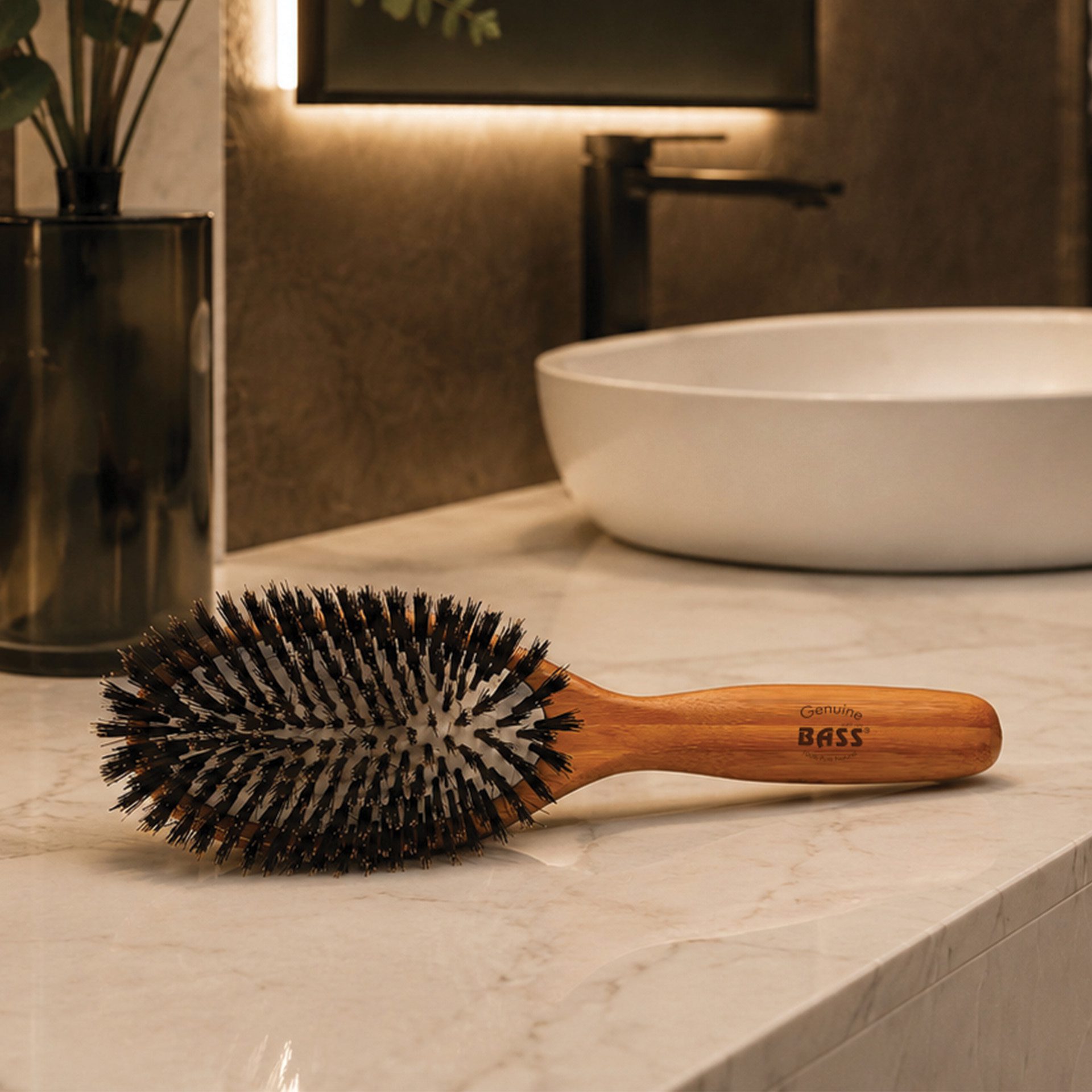
By Joel Weinstein, President and Editorial Director of Bass Brushes. This article is part of a special PBA series on Hairbrushes and expands on Bass Brushes’ broader educational textbook on boar bristle hairbrushes.
Key Takeaways
· As the population of older adults grows, salons will increasingly serve clients with gray and aging hair. Understanding how boar bristle brushes interact with changing density, texture, oil distribution, scalp sensitivity, and fiber condition is becoming an important part of professional salon practice.
· Gray color alone does not determine the correct brushing approach. Stylists must assess the client’s actual density, texture, condition, processing history, scalp tolerance, and desired finish.
· A boar bristle brush is primarily a natural-oil distribution, surface-refinement, and finishing tool. It should be used on dry, fully detangled hair and is not a primary detangling tool or a treatment for hair loss, scalp disorders, or structural damage.
· Brush construction, section size, pressure, and repetition should be adjusted to the individual client. Sectioning should replace force, and fragile, sparse, sensitive, or chemically processed areas generally require lighter contact and fewer passes.
· There is no universal stroke count. Brushing should stop once the desired polish, cohesion, oil distribution, and flyaway control have been achieved—or sooner if resistance, static, roughness, volume loss, breakage, or discomfort increases.
Why Gray Hair Requires a More Deliberate Brushing Approach
Boar bristle brushing can look deceptively simple. In professional use, however, the result depends on far more than moving a brush through the hair. The stylist must understand what the brush is meant to accomplish, whether its construction suits the client, where it belongs in the service, and how much contact the hair and scalp can tolerate.
A boar bristle brush is primarily used to move existing natural oils through prepared hair, refine the fiber surface, and improve the appearance of a dry, fully detangled style. With gray, silver, and aging hair, applying that purpose well requires closer judgment because the material conditions can vary dramatically from one client to another.
One client may have dense, resistant silver hair that limits bristle access. Another may have fine, low-density hair that loses volume quickly under repeated passes. Others may present with wiry roots, fragile ends, mixed gray and pigmented fibers, chemical processing, product buildup, increased scalp exposure, or several of these conditions at once.
This is why gray-hair brushing cannot be reduced to choosing a softer or firmer brush according to age or color. Gray hair may appear early in life, while aging hair may change in density, oil distribution, texture, or tolerance without becoming fully gray. The subjects overlap, but they are not interchangeable.
By 2030, adults age 65 and older are projected to account for 20.63% of the U.S. population (U.S. Census Bureau, 2023 National Population Projections, Table 2). For salons serving mature clients, the ability to assess these differences is both professional responsibility and a service opportunity. Stylists who understand brush construction, sectioning, pressure, and stopping criteria can create polish and cohesion without automatically flattening volume, disturbing texture, or overworking vulnerable areas.
The practical distinction is this: gray hair is a visible characteristic, not a complete technical diagnosis. The brush and technique must be chosen according to the actual hair and scalp—not color or age alone.
Begin with Consultation and Assessment
Before selecting a brush, the stylist should establish both the client’s goal and the hair’s current tolerance. These are separate questions, and both matter.
Begin with the desired result. The client may want greater polish or luminosity, fewer flyaways, less static, a softer-looking surface, more control over wiry areas, or a sleeker finish. Others may care more about preserving natural texture, visible volume, or the movement created during a blowout. Not every client wants gray hair to look uniformly smooth, compressed, or flattened. The brushing plan should support the intended finish rather than impose one standard result.
The consultation should also uncover relevant history. Ask about color, bleach, toner, smoothing treatments, and other chemical services, as well as heat-styling habits, dry-shampoo use, layered products, current home brushes and brushing methods. Discuss scalp tenderness, sensitivity, discomfort, recent changes in shedding, density, breakage, or texture, and any areas the client avoids during grooming. A routine that once felt comfortable may no longer suit the hair after processing, density changes, increased sensitivity, or shifts in product use.
The physical assessment then determines what the hair and scalp can tolerate during that appointment. Evaluate fiber diameter, texture, surface behavior, density, dryness, brittleness, structural condition, processing history, existing breakage, buildup, and differences from roots to ends. Look for mixed gray and pigmented fibers, naturally gray roots with processed lengths, and areas where the material condition changes.
These distinctions are critical. Fine hair may still be dense. Coarse hair may be low-density. Wiry fibers may be dry, porous, or fragile. Healthy-looking roots may coexist with vulnerable, chemically processed ends. The hair and scalp may also have different tolerances: resilient lengths do not justify firm contact over a tender or exposed scalp.
Observe for visible irritation, broken skin, areas of reduced density, and greater scalp exposure, while asking about tenderness, sensitivity, pain, burning, or discomfort. The stylist’s role is to assess suitability and modify the service—not to diagnose a medical condition.
The consultation identifies the client’s goals and history. The physical assessment determines what the hair and scalp can safely and comfortably tolerate that day.
Select the Brush by Construction and Response
Brush selection should begin with the contact the tool creates—not with a generic label such as “soft,” “firm,” or “for gray hair.” Two brushes within the same category can behave very differently because of bristle stiffness, length, density, mounting, shape, and the presence or absence of synthetic pins.
For fine, fragile, low-density, or scalp-sensitive presentations, softer and more yielding boar bristles are generally the better starting point. Use lighter contact, fewer passes, and particular caution around sparse areas, the temples, crown, and hairline. A few wiry fibers do not automatically justify a firmer brush. The stylist must consider the overall density, fragility, scalp exposure, and desired volume before increasing firmness.
Medium-density hair may tolerate moderate bristle firmness, but the first adjustment should not always be a stronger brush. If contact is limited, consider reducing the section size, changing the brush angle, modifying the point of contact, or refining the technique. A brush that appears too soft may simply be working through too much hair at once.
Thick, dense, coarse, or resistant hair may require firmer or longer bristles, smaller sections, or a mixed-bristle construction that provides greater penetration. Resistance should be managed through access and construction—not downward force.
Pure boar brushes may be especially useful for surface polishing, natural-oil distribution, gentle finishing, flyaway control, and refinement without aggressive separation. They may perform well on fine or moderate-density hair, or whenever the stylist’s goal is broad surface contact rather than deeper penetration.
Boar-and-nylon hybrids may be useful when dense or resistant hair prevents pure boar from reaching effectively through the section. The longer synthetic pins can assist separation and penetration while the boar bristles contribute surface refinement. The hair must still be fully detangled before use. The synthetic component should not be relied on to pull through knots or matting.
Some mixed-bristle arrangements are described as “porcupine-style,” but that term is not standardized and should not be treated as a universal synonym for every hybrid brush.
Other construction variables also matter. Longer bristles may improve access through dense sections. Densely packed bristles can create broad, even contact but may also increase drag on dry, porous, or product-coated hair. Cushion-mounted designs may feel more yielding, while direct-set bristles can create more immediate contact. Brush size and shape influence precision, section control, and whether the tool is better suited to surface polishing or deeper engagement.
The best brush is not determined by gray hair as a category. It is determined by the contact its construction creates in the client’s actual hair.
Apply a Controlled Salon Technique
Effective boar bristle brushing depends on five practical controls: preparation, service placement, sectioning, zone-specific contact, and stopping by response.
Prepare the Hair
Traditional boar bristle conditioning and finishing should generally be performed on dry, fully detangled hair.
Detangling should be completed first with an appropriate comb, pin brush, or other suitable tool, working progressively from the ends upward. The boar bristle brush should be introduced only after knots and meaningful resistance have been removed.
Even a boar-and-nylon hybrid should not be used to pull through tangles or matting. Its synthetic pins may improve penetration through dense, already prepared hair, but they do not convert the brush into a primary detangling tool.
Before proceeding through a full section, test the passage with light contact. The brush should move without catching, compressing the hair, pulling at the roots, or requiring added force. If it does not, reassess the detangling, section size, product load, or brush construction.
Place the Brush Deliberately Within the Service
Boar bristle brushing should have a defined purpose at the moment it is used.
It may be introduced selectively before shampooing to observe surface behavior, oil distribution, or minor buildup. After complete detangling, it may be used for surface refinement and controlled oil distribution. Before finishing-product application, it can help the stylist determine whether additional product is necessary. A clean brush may also distribute a very small amount of a suitable finishing product through prepared hair.
Following blow-drying or shaping, boar bristles may help blend sections, calm flyaways, soften an overly rigid finish, or add cohesion without another heat pass. During final finishing, the brush should refine the completed style rather than reconstruct it.
It should never be added automatically simply because the client has gray hair. If the intended finish is already present, additional brushing may offer no advantage.
Create Access Through Sectioning
Sectioning should replace force.
Smaller sections can improve bristle access through thick, dense, coarse, or resistant hair. They allow the brush to engage the intended fibers without compressing a large mass of hair or increasing downward pressure.
Larger sections may be sufficient for fine or low-density hair, particularly when the goal is broad surface polishing. Fine hair should not automatically be divided into very small sections if doing so creates more total scalp contact or more brushing than the result requires.
The entire head does not need to be sectioned uniformly. Dense crown areas may need smaller sections, while low-density zones may require broader, lighter contact. Resistant roots and vulnerable processed lengths may also need different section depths.
When the brush does not reach effectively, adjust the section or the brush—not the force.
Adjust Contact by Zone
At the roots and scalp, use controlled contact rather than scraping or pressing. Reduce pressure over sparse, tender, sensitive, or exposed areas, and avoid repeatedly working
the same scalp zone. Stop immediately if the client reports pain, burning, scratching, heat, or increasing tenderness.
Through the mid-lengths, use smooth, deliberate passes. Support long or heavy sections with the free hand when necessary to reduce root tension. If drag, roughness, static, or pulling increases, stop and reassess.
The ends generally require the least pressure and repetition because they are often the oldest and most weathered part of the fiber. Dry, split, bleached, brittle, or porous ends may need one light pass—or no pass at all.
Around the hairline and temples, use smaller sections, lighter contact, and fewer passes. Avoid pulling sparse or fragile hairs backward under tension.
At the crown and through dense zones, improve access with smaller sections or a more appropriate construction. Do not force the bristles downward.
Follow the Haircut and Stop by Response
The brush should reinforce the haircut rather than override it. Preserve directional lift in short cuts, maintain the perimeter and bend of structured shapes, retain separation through layers, support the weight of long hair, and use localized contact around bangs and face-framing sections.
The client’s preferred volume, movement, and texture should remain intact.
There is no universal stroke count. Stop when polish and light reflection have improved, surface oils have been distributed appropriately, flyaways are controlled, the brush still moves freely, and further passes no longer improve the result.
The professional objective is appropriate contact—not maximum pressure, penetration, shine, or repetition.
Adapt to Common Presentations and Service Conditions
Fine, fragile, or low-density gray hair generally benefits from softer bristles, lighter contact, and fewer passes. The stylist should preserve visible volume rather than pursuing maximum smoothness or shine. Sparse areas, the hairline, temples, and crown require particular restraint because the scalp may be more exposed and the remaining fibers may receive more direct contact. Repeated brushing over the crown can flatten fine hair before the surface looks meaningfully more polished.
Coarse, wiry, or dense gray hair may require smaller sections, firmer bristles, longer bristles, or a mixed-bristle construction that provides greater access. The objective is to reach the hair more effectively without increasing downward force. A successful result may show improved cohesion and light reflection while retaining some natural texture. Brushing should stop before the hair becomes stiff, increasingly static, compressed, or unnaturally flat.
Dry or brittle gray hair should be completely detangled and appropriately conditioned before boar bristles are introduced. Use light pressure, limited passes, and minimal repetition through the ends. Dryness is not a reason to brush more aggressively. If the hair becomes rougher, more rigid, more static, or increasingly resistant, the technique is no longer improving the result and should be reduced or stopped.
When oily roots coexist with dry ends, contact should be concentrated where it is useful. Controlled brushing near the roots and through the mid-lengths may help redistribute some existing surface oil, but the driest ends may need fewer passes or no full-length repetition. The goal is balanced distribution—not carrying all available root oil downward. Excess transfer can make pale gray or silver lengths appear darker, separated, cloudy, heavy, or flat, reducing clarity, movement, and volume.
Partially gray or mixed-texture hair may contain pigmented and nonpigmented fibers that differ in diameter, surface behavior, condition, and resistance. One section may tolerate more contact while another requires a softer approach. Section size, pressure, brush angle, and repetition should change wherever the material condition changes rather than remaining uniform across the head.
Naturally gray roots combined with processed lengths require the same zone-specific thinking. Resistant roots may need smaller sections or greater bristle access, while color-treated, bleached, porous, or weathered lengths require lighter pressure and fewer passes. The brush that works effectively at the roots may not be appropriate for repeated use through the ends. Excessive oil transfer should also be avoided through pale, porous, or chemically treated lengths.
Wavy, curly, and coily gray hair requires style-specific judgment. Full-length dry brushing can separate curl groupings, expand the silhouette, increase visible frizz, or erase the intended pattern. Boar bristles may be used selectively for localized surface refinement, flyaway or edge control, or on styles that have already been stretched, wrapped, or smoothed. When preserving natural curl definition is the goal, another finishing tool—or no full-length brushing—may be the more appropriate choice.
Fresh color, toner, bleach, smoothing, and other chemical services require immediate reassessment. Hair that looks visually finished may still be unusually weak, soft, elastic, rough, swollen, or unstable. When those signs are present, contact should be minimized or postponed. Manufacturer aftercare guidance should be followed, and the stylist should remember that a boar bristle brush cannot repair structural damage created during processing.
Product buildup also changes how the brush performs. Dry shampoo, powder, oil, hairspray, and accumulated styling residue may increase drag, reduce bristle access, and collect within the brush. Brushing should not be used to correct substantial buildup. On pale hair, excess residue may appear as dullness, cloudiness, darkness, separation, or heaviness. The brush must be clean, and the service should stop before silver clarity, movement, or volume begins to decline.
Know When to Stop, Modify, or Avoid Brushing
Professional judgment includes recognizing the difference between normal completion, a technique problem, a locally unsuitable area, and a service that should not proceed.
Normal completion occurs when the intended polish, oil distribution, and surface control have been achieved and additional passes no longer improve the result. The service should also stop for reassessment if the brush begins to catch, resistance increases, more pressure would be required, or the hair becomes rougher, more rigid, or more static. Collapsing volume, increasingly distressed ends, oily or cloudy pale lengths, and client discomfort are also signs that the current approach is no longer beneficial.
Reassessment may lead to a smaller section, lighter contact, a different brush construction, fewer passes, or omission of a particular zone. A tender hairline, exposed scalp area, or vulnerable processed section may require local avoidance even when the rest of the service can continue.
Brushing should be postponed or avoided entirely when active irritation, broken skin, visible lesions, or unexplained redness are present. It should also not proceed through severe tangling, matting, active breakage under minimal handling, sudden or unusual shedding, or hair that feels unusually weak or unstable after processing. Recent procedures that restrict pressure, friction, or scalp contact must also be respected. The client’s distress or discomfort is sufficient reason to stop.
The stylist’s responsibility is to observe, modify the service, and discontinue brushing when appropriate. Persistent, sudden, worsening, or unexplained concerns should be referred to an appropriately qualified medical professional. The stylist should not diagnose scalp disease, explain the biological cause of shedding, or suggest that brushing can treat hair loss.
Tool suitability is part of the same professional decision. Captured hair and residue must be removed between clients, and all applicable sanitation, licensing, and salon requirements must be followed. Manufacturer care instructions describe how to protect the brush; they do not replace professional regulations. A natural-bristle brush should not be circulated between clients if its construction cannot tolerate the required cleaning and disinfection process. Damaged, rough, contaminated, or inadequately cleanable tools should be removed from service.
Professional sanitation note: Manufacturer cleaning guidance does not supersede applicable licensing, state-board, or salon sanitation requirements.
Extend the Service Through Appropriate Home Guidance
The brush used for salon finishing may not be the best choice for independent home use. A stylist can control section size, pressure, angle, and contact with precision; a client may have limited visibility, reduced hand strength, difficulty reaching certain areas, or a tendency to repeat a fixed number of strokes.
Home recommendations should therefore consider grip, hand control, hair density, scalp sensitivity, haircut structure, the client’s ability to section the hair, and the risk of overbrushing. In some cases, a softer or more forgiving brush may be more appropriate than the tool used during the professional service.
Demonstrate a simple routine the client can repeat safely. Teach them to detangle first with an appropriate tool, use the boar bristle brush on dry hair, begin with light pressure, and work in manageable sections. The brush should follow the haircut, with fewer passes over fragile ends and reduced contact over sparse or sensitive areas. Brushing should stop once the desired polish has been reached.
Clients should also remove captured hair, clean the brush according to its construction, and allow it to dry fully before reuse. They should discontinue brushing if pain, irritation, breakage, or unusual shedding increases. When changes are persistent or unexplained, they should consult their stylist or an appropriately qualified medical professional.
Home brushing supports controlled grooming, surface-oil distribution, refinement, and finishing. It is not a hair-growth or hair-loss treatment
Conclusion: Professional Judgment Determines the Result
Gray and aging hair is an important area of salon expertise, but it cannot be served through one fixed brushing routine. Gray color does not reveal whether the hair is fine or coarse, dense or sparse, resilient or fragile, naturally textured or chemically altered. Nor does age determine how much pressure, penetration, or repetition a client can tolerate.
The stylist must evaluate the individual hair and scalp, then adjust brush construction, section size, contact, service placement, and number of passes according to the response observed during the appointment.
When appropriately selected and used, boar bristles may support natural-oil distribution, surface refinement, luminosity, cohesion, and controlled finishing. Their professional value does not come from using greater force or completing a prescribed number of strokes. It comes from knowing where the brush belongs, how much contact is useful, and when another pass—or another tool—would no longer improve the result.
Success depends on restraint, observation, and professional judgment.
The most effective boar bristle brushing is not the technique applied most aggressively or most often. It is the technique that gives the individual client’s hair exactly the contact it can benefit from—and no more.
Frequently Asked Questions
Is a boar bristle brush good for gray hair?
A boar bristle brush can be useful for gray hair when its construction and technique are matched to the individual client. On dry, fully detangled hair, it may help distribute existing natural oils, refine the fiber surface, improve luminosity, control flyaways, and create a more cohesive finished appearance. Gray color alone, however, does not determine whether a particular brush or brushing method is suitable.
What does a boar bristle brush do for gray hair?
A boar bristle brush primarily functions as a natural-oil distribution, surface-refinement, and finishing tool. It may improve polish, light reflection, surface alignment, flyaway control, and visual cohesion. It does not internally hydrate the hair, repair structural damage, replace conditioning, or treat scalp or hair-loss conditions.
Should a boar bristle brush be used on wet or dry gray hair?
Traditional boar bristle conditioning and finishing should generally be performed on dry, fully detangled hair. Knots and meaningful resistance should first be removed with an appropriate comb, pin brush, or other detangling tool before the boar bristle brush is introduced.
Can a boar bristle brush be used to detangle gray hair?
A boar bristle brush should not be used as the primary tool for removing knots, tangles, or matting. Even boar-and-nylon hybrid brushes should be used only after the hair has been fully detangled. Their longer synthetic pins may improve access through dense, prepared hair, but they should not be relied upon to pull through resistance.
What type of boar bristle brush is best for gray hair?
The best brush depends on the client’s density, fiber diameter, texture, condition, scalp tolerance, processing history, and desired finish. Softer, more yielding bristles are generally a better starting point for fine, fragile, low-density, or scalp-sensitive hair. Dense, coarse, or resistant hair may require longer or firmer bristles, smaller sections, or a boar-and-nylon construction that provides greater penetration without added force.
How many times should gray hair be brushed with a boar bristle brush?
There is no universal stroke count. Brushing should stop once the desired polish, oil distribution, cohesion, and flyaway control have been achieved. It should be reduced or stopped sooner if resistance, static, roughness, pulling, volume loss, breakage, scalp discomfort, or distressed ends begin to increase.
Can boar bristle brushing damage gray hair?
Boar bristle brushing can overwork gray hair when the brush is too firm, the sections are too large, or excessive pressure and repetition are used. Fine, brittle, chemically processed, sparse, or weathered areas generally require lighter contact and fewer passes. Sectioning, brush construction, and access should be adjusted instead of increasing force.
Is a boar bristle brush suitable for curly, wavy, or coily gray hair?
It depends on the intended style. Full-length dry brushing can separate curl groupings, expand the silhouette, increase visible frizz, or reduce definition. Boar bristles may be used selectively for surface refinement, flyaway control, edge control, or styles that have already been stretched, wrapped, or smoothed. When preserving natural curl definition is the priority, another finishing tool—or no full-length brushing—may be more appropriate.
Can a boar bristle brush help with thinning hair or hair loss?
A boar bristle brush does not grow hair, reverse thinning, treat alopecia, stop biological shedding, or address the medical causes of hair loss. On fine or low-density hair, careful brush selection and controlled technique may help refine the finished appearance without unnecessarily flattening volume or overworking exposed areas.
When should a stylist avoid using a boar bristle brush?
Brushing should be postponed or avoided when there is active irritation, broken skin, visible lesions, unexplained redness, severe tangling, matting, active breakage under minimal handling, sudden or unusual shedding, or hair that feels weak or unstable after chemical processing. Pain, burning, scratching, increasing tenderness, or client distress are also sufficient reasons to stop. Persistent or unexplained concerns should be referred to an appropriately qualified medical professional.